86. Partition List
Given the head of a linked list and a value x, partition it such that all nodes less than x come before nodes greater than or equal to x.
You should preserve the original relative order of the nodes in each of the two partitions.
Example 1:
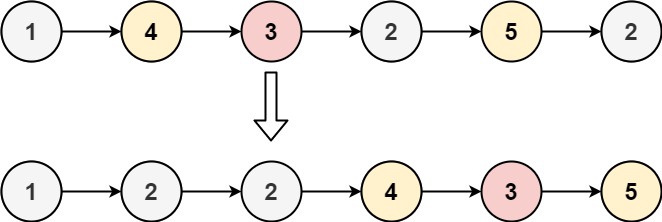
Input: head = [1,4,3,2,5,2], x = 3 Output: [1,2,2,4,3,5]
Example 2:
Input: head = [2,1], x = 2 Output: [1,2]
Constraints:
- The number of nodes in the list is in the range
[0, 200]. -100 <= Node.val <= 100-200 <= x <= 200
/**
 * Definition for singly-linked list.
 * struct ListNode {
 *     int val;
 *     ListNode *next;
 *     ListNode() : val(0), next(nullptr) {}
 *     ListNode(int x) : val(x), next(nullptr) {}
 *     ListNode(int x, ListNode *next) : val(x), next(next) {}
 * };
 */
class Solution {
public:
    ListNode* partition(ListNode* head, int x) {
        // 建立兩條 linked list: node1, node2;
        ListNode* node1 = new ListNode(-1);
        ListNode* node2 = new ListNode(-1);
        ListNode* ptr1 = node1;
        ListNode* ptr2 = node2;
        while (head) {
            // 如果 head 的 val 比 x 小
            if (head->val < x) {
                // 將 head 接到 ptr1->next
                ptr1->next = head;
                // 移動 ptr1
                ptr1 = ptr1->next;
            } else {
                // 反之,接到 ptr2
                ptr2->next = head;
                // 移動 ptr2
                ptr2 = ptr2->next;
            }
            // 移動 head
            head = head->next;
        }
        // ptr2->next 為尾端 NULL
        ptr2->next = nullptr;
        // ptr1 後面接 node2->next
        ptr1->next = node2->next;
        // 最後返回 node1->next
        return node1->next;
    }
};- T:
- S: